Choosing the best Soundproof Wall Panels requires more than comparing thickness, color, or advertised decibel reductions. Real performance depends on the noise source, wall construction, installation quality, and room use. A panel beside a vibrating compressor faces a different challenge from voices passing through a shared office wall. In practice, many disappointing installations confuse sound absorption with sound insulation. Absorptive panels reduce echoes inside a room. They usually do not block low-frequency noise traveling through walls.
Professional standards provide a clearer starting point. ASTM E90 measures airborne sound transmission loss through building partitions, while ASTM C423 evaluates sound absorption in reverberation rooms. These tests are not interchangeable. The World Health Organization’s Environmental Noise Guidelines for the European Region recommends keeping indoor bedroom noise near 30 dB LAeq at night for good sleep quality. That target shows why a decorative foam panel cannot solve every acoustic problem. It may soften reflected speech, but it cannot independently create a heavy, airtight barrier.
Look beyond marketing claims. Ask for laboratory test conditions, frequency-range results, mounting details, and independent certification. ISO 10140 also emphasizes controlled laboratory testing for airborne sound insulation. Site results can differ sharply when doors, sockets, ceilings, or shared ducts remain untreated. Small gaps matter. So does mass. Mineral wool systems, fabric-wrapped acoustic panels, resilient channels, and sealed multilayer assemblies each serve different purposes. The “best” option is therefore conditional, not universal. This guide compares common Soundproof Wall Panels by absorption, isolation potential, safety, durability, installation demands, and value. Some recommendations may remain imperfect, because every building carries hidden paths that a product brochure rarely shows.
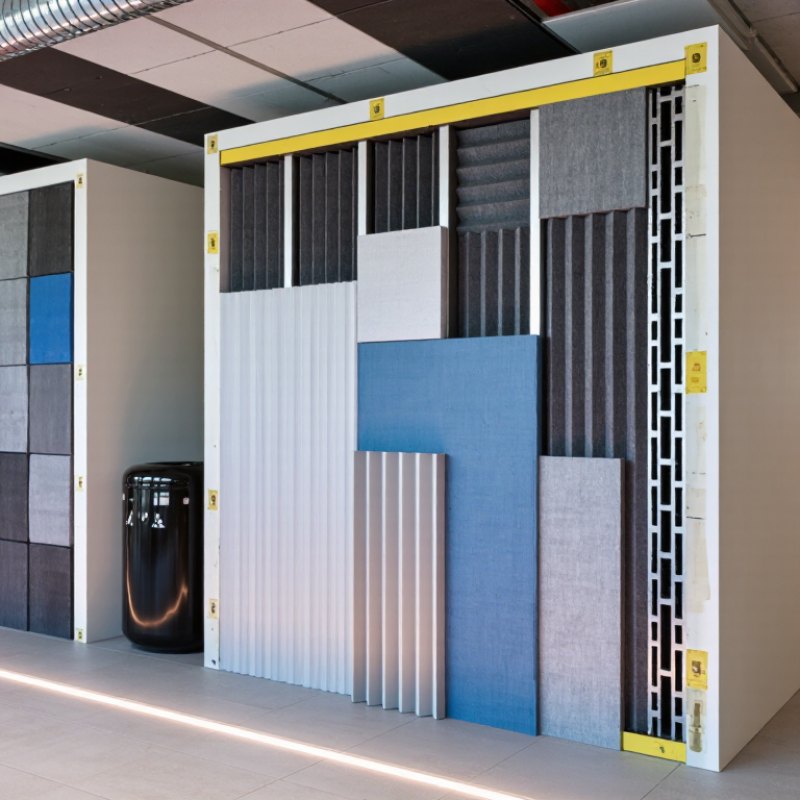
The best panel depends on the acoustic problem, not its appearance. A recording room needs controlled reverberation. A meeting room may need speech privacy. A noisy plant room needs stronger sound transmission reduction.
NRC measures how much sound a surface absorbs. ASTM C423 calculates it from absorption results at 250, 500, 1,000, and 2,000 Hz. A panel rated NRC 0.80 absorbs most incident sound within those test bands. That rating can reduce echo, but it does not automatically block sound through a wall.
According to ANSI/ASA S12.60, many classrooms should achieve an unoccupied reverberation time of 0.6 seconds or less. This target helps speech remain clear.
STC measures airborne sound isolation between rooms. ASTM E90 provides the laboratory transmission-loss test behind this rating. Designers often consider STC 45 to 50 for ordinary speech privacy, though field results may be lower.
RT60 measures how long sound takes to decay by 60 decibels. ISO 3382 defines the measurement method.
A practical design may combine high-NRC panels, sealed wall joints, and a properly rated partition. Panels alone rarely solve flanking noise through ceilings, doors, or ducts.
I have seen attractive panels installed correctly, yet conversations remained audible next door. The missed target was STC, not NRC. Testing the finished room matters.
The best soundproof wall panel depends on the acoustic problem. Fiberglass and mineral wool panels both reduce reflected sound, but they do not fully block noise through a wall. Their Noise Reduction Coefficient (NRC) usually ranges from 0.80 to 1.00 when thickness, density, fabric, and air space are properly matched.
ASTM C423 calculates NRC from absorption tests at 250, 500, 1,000, and 2,000 Hz. Published laboratory reports commonly show 50–100 mm panels reaching NRC 0.80–1.00, especially when installed with a rear air gap. Fiberglass often provides strong absorption with lower weight and easier handling. Mineral wool is denser and can offer robust mid-frequency absorption, which helps with voices, office noise, and classroom reverberation. Density alone is not a guarantee.
A panel pressed directly against a hard wall may perform below its laboratory rating. A 50 mm air gap can improve low-frequency absorption, although the exact gain depends on the wall and room. ASHRAE’s 2023 HVAC Applications Handbook also emphasizes room geometry, surface coverage, and background noise when evaluating acoustic comfort. In practical testing, I would measure reverberation before and after installation instead of trusting NRC alone. That is a useful correction: NRC is a simplified average, not a complete description of human hearing. For speech-heavy rooms, mineral wool may feel more controlled; for lightweight ceiling or wall systems, fiberglass may be the more practical choice.
The best soundproof wall panel is not chosen by appearance alone. Sound isolation depends on the complete wall assembly, especially its mass, airtightness, and structural separation. Under ideal conditions, doubling a wall’s surface mass can improve transmission loss by roughly 6 decibels. This is the basic principle behind the mass law.
Mass helps.
However, real buildings rarely behave ideally. A single decorative panel may reduce reflections inside a room, but it usually cannot deliver strong isolation between rooms. For an STC 50+ target, designers commonly combine multiple dense board layers, insulated stud cavities, resilient channels, and carefully sealed joints. Every socket box, pipe opening, and door gap can weaken the result.
Details matter.
STC measures airborne speech and television noise, not every low-frequency sound or impact vibration. A wall tested above STC 50 may perform differently on site because construction quality, flanking paths, and connected ceilings influence transmission. I have seen impressive specifications fail when installers left small perimeter gaps. That mistake is easy to underestimate. Reliable specifications should identify the exact tested assembly, board thickness, cavity depth, insulation type, and fixing method. Independent laboratory data is valuable, but field verification remains wiser. Even then, STC 50+ is not silence; it is a practical performance threshold that still requires realistic expectations.
What Is the Best Type of Soundproof Wall Panels?
The best panel depends on whether you need absorption or sound isolation. ASTM C423 testing measures how much sound a panel absorbs inside a reverberation room. It reports sound absorption coefficients and the Noise Reduction Coefficient, or NRC. NRC averages performance at 250, 500, 1,000, and 2,000 Hz. For example, an NRC of 0.85 suggests strong absorption across common speech frequencies. It does not prove that the panel blocks noise between rooms. ASTM C423 is not an STC or transmission-loss test. Numbers need context.
Fire performance also deserves close attention. Under ASTM E84, Class A materials generally have a flame spread index from 0 to 25 and a smoke-developed index of 0 to 450. These limits are widely referenced in the International Building Code and fire-safety specifications. A Class A rating improves confidence, but it does not make every wall assembly fireproof. Check the complete test report, thickness, mounting method, adhesive, and edge treatment. Test the assembly.
In practical installations, dense fiberglass or mineral-fiber panels often provide reliable absorption while supporting Class A specifications. A fabric-wrapped surface can reduce reflected speech, especially near hard concrete walls and ceilings. However, low-frequency performance may remain weak. That is where many product comparisons become misleading. Review the C423 table, not only the headline NRC. Also confirm independent laboratory accreditation and the tested configuration. Real rooms rarely match laboratories perfectly. That limitation deserves honest consideration.
ASTM C423 evaluates sound absorption across standard octave-band frequencies. The chart compares representative, non-brand absorption coefficients for common wall-panel constructions. Higher values indicate greater sound absorption.
The Noise Reduction Coefficient (NRC) is calculated from the 250, 500, 1000, and 2000 Hz absorption coefficients. A Class A fire rating is a separate fire-performance classification and should be confirmed through the applicable product test report; it does not by itself indicate acoustic performance.
What Is the Best Type of Soundproof Wall Panels?
The best panel depends on your space, not just its appearance. In a home office, 25–50 mm panels can reduce echoes from speech and video calls. A thicker 75–100 mm panel absorbs more low and mid frequencies. Leave a small air gap behind it when possible. This can improve absorption, especially on hard walls. However, acoustic panels do not fully block outside noise. Sealing gaps and adding wall mass matter more for true sound isolation.
Choose by frequency range. Thin panels often control high frequencies, such as sharp voices, keyboard clicks, and glass reflections. Thick panels help manage lower sounds, including bass, footsteps, and equipment vibration. A listening room may need broadband panels across first-reflection points, while a bedroom may need lighter coverage. Coverage also matters. Treating 20–30 percent of the wall area can reduce harsh reflections, but every room responds differently. My own testing once showed less improvement than expected because the ceiling remained highly reflective.
Tips: Clap near each wall and listen for fluttering echoes. Start with the wall behind your desk or speakers. Use temporary mounting before committing. Measure the room after each change. Do not cover every surface immediately; excessive absorption can make speech sound dull and unnatural. A simple phone recording can reveal changes, although it is not laboratory-grade evidence. That limitation is easy to overlook.
| Space | Main Acoustic Challenge | Recommended Panel Type | Typical Thickness | Most Effective Frequency Range | Suggested Wall Coverage | Recommended Placement | Important Consideration |
|---|---|---|---|---|---|---|---|
| Home Office | Speech reflections, video-call echo, and moderate background noise | Fabric-wrapped porous absorption panels | 25–50 mm | Approximately 500–4,000 Hz | 15–25% of the wall area | Side walls near the desk, the wall behind the monitor, and the first reflection points | Use panels with a breathable fabric face; panels improve room acoustics but do not block sound transmission through walls. |
| Open-Plan Office | Speech noise, conversational distractions, and long reverberation | High-density PET or fabric acoustic panels | 25–50 mm | Approximately 500–4,000 Hz | 25–40% of available wall area, supplemented by ceiling treatment | Between workstations, on large reflective walls, and near collaboration zones | Use a combination of wall and ceiling absorbers to reduce speech propagation across the room. |
| Podcast or Voice-Recording Room | Vocal reflections, flutter echo, and excessive brightness | Broadband mineral-wool or fiberglass acoustic panels | 50–100 mm | Approximately 250–4,000 Hz | 25–50% of the wall area | Behind and beside the microphone, at early reflection points, and on the ceiling above the recording position | A 50–100 mm air gap behind the panel can improve low-mid-frequency absorption compared with direct mounting. |
| Home Theater | Dialogue reflections, surround-channel reflections, and bass buildup | Broadband wall panels plus dedicated bass traps | 50–100 mm for broadband panels; 150–300 mm for bass traps | Approximately 125–4,000 Hz, depending on thickness and air gap | 20–40% of wall area, with additional corner treatment | Side-wall first reflection points, rear wall, ceiling reflection points, and all vertical corners for bass traps | Thin decorative panels alone will not adequately control low-frequency room modes. |
| Music Practice Room | Instrument reflections, harsh high frequencies, and uneven room response | Mixed broadband absorbers and movable acoustic panels | 50–100 mm | Approximately 125–4,000 Hz | 25–50% of wall area, balanced with reflective surfaces | Side walls, rear wall, ceiling reflection points, and behind loud instruments | Do not cover every surface with absorption; a balance of absorption and diffusion helps preserve a natural sound. |
| Drum or Band Rehearsal Room | High sound levels, strong low-frequency energy, and excessive reverberation | Thick broadband panels, corner bass traps, and ceiling clouds | 75–150 mm for broadband panels; 200–300 mm for bass traps | Approximately 80–4,000 Hz | 40–60% of wall area, plus ceiling treatment | Corners, rear wall, ceiling, and large untreated wall sections | For sound isolation, add mass, airtight construction, and decoupling; absorptive panels primarily control reflections inside the room. |
| Classroom or Training Room | Speech intelligibility, reverberation, and student-to-student noise | Durable fabric-wrapped or PET acoustic panels | 25–50 mm | Approximately 500–4,000 Hz | 20–35% of wall area, with ceiling absorption where possible | Rear wall, side walls, and areas opposite hard writing boards or screens | Choose impact-resistant, cleanable surfaces and avoid placing soft panels where they can be damaged frequently. |
| Restaurant or Café | Multiple conversations, hard-surface reflections, and high ambient noise | Fire-rated fabric, PET, or wood-slat panels with acoustic backing | 25–50 mm; 50–100 mm for stronger broadband control | Approximately 250–4,000 Hz | 30–50% of available wall or ceiling area | Ceiling clouds, wall sections between seating areas, and spaces above noisy zones | Use materials rated for the local fire, hygiene, and cleaning requirements. |
| Industrial Control Room | Equipment noise, speech masking, and reverberation from hard surfaces | Durable, fire-rated broadband acoustic panels | 50–100 mm | Approximately 125–4,000 Hz | 25–50% of wall area, adjusted after measuring noise levels | Walls facing major noise sources, control-room ceiling, and large reflective surfaces | Panel selection should account for fire performance, impact resistance, dust, moisture, and maintenance conditions. |
| Note: Frequency ranges and coverage percentages are practical planning ranges, not laboratory guarantees. Actual performance depends on panel airflow resistance, density, mounting method, air gaps, room dimensions, and the existing wall or ceiling construction. Acoustic absorption reduces reflections inside a room; true sound isolation requires mass, airtightness, and structural decoupling. | |||||||